 |
| Image by Apasciuto |
†
A GREETING
God’s spirit made me;
the Almighty’s breath enlivens me.
(Job 33:4)
A READING
When God began to create the heavens and the earth—
the earth was without shape or form, it was dark over the deep sea,
and God’s wind swept over the waters.
(Genesis 1:1)
MUSIC
A MEDITATIVE VERSE
The Lord God formed the human from the topsoil of the fertile land
and blew life’s breath into his nostrils. The human came to life.
(Genesis 2:7)
A POEM
You who let yourselves feel: enter the breathing
that is more than your own.
Let it brush your cheeks
as it divides and rejoins behind you.
Blessed ones, whole ones,
you where the heart begins:
You are the bow that shoots the arrows
and you are the target.
Fear not the pain. Let its weight fall back
into the earth;
for heavy are the mountains, heavy the seas.
The trees you planted in childhood have grown
too heavy. You cannot bring them along.
Give yourselves to the air, to what you cannot hold.
- from Sonnet IV, Part One of "Sonnets to Orpheus",
by Rainer Maria Rilke, translated by Anita Barrows and Joanna Macy
VERSE OF THE DAY
The breath of a person is the lamp of the Lord,
searching all the inmost parts.
(Proverbs 20:27)
†
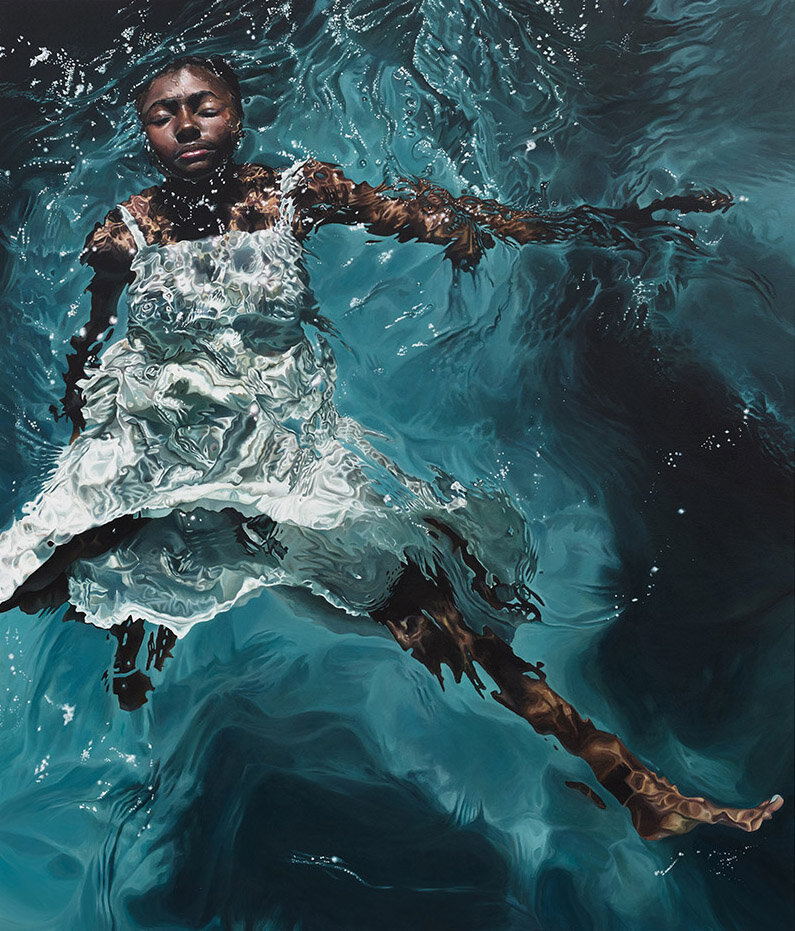 |
| "Radiating My Sovereignty" by Calida Garcia Rawles (2019) Los Angeles-based artist Rawles paints figures immersed in water, fully clothed. This painting retells the tradition of Lilith, a figure in Jewish mysticism who was believed to have been created at the same time as Adam (see Gen 1:27) and who left the garden after refusing to be subservient to him. Recasting the myth as an expression of independence, the body and face express a oneness with environment. |
The torso of the body is the container for our lungs, that which gives us breath and life. The lungs are never mentioned in scripture, but words for "breath" appear more than a hundred times. The Hebrew word "ruach," is "breath" and also "wind" and "spirit." God breathes as the first act of Creation, when "ruach" moves over the face of the deep.
The breath of God is breathed into each of us at our birth and stays with us until the end. During the years inbetween, our breath reflects our state of being: when we are anxious it shortens, when we are relaxed or happy it lengthens. We pant heavily in the act of childbirth, our breath freezes when we have fear. We can see our breath in cold weather, we make bubbles with it underwater when we swim. We sometimes learn to control our breath: when we practice yoga or tai chi or when we are learning to sing, the control of our breath becomes a way of managing our wellness, and expressing our innermost passion.
When we love someone intimately, our breath mingles with theirs: from parent to child, from partner to spouse, from caregiver to loved one. In the same way, God's breath is always within us, stirring us and nurturing us. The wind/breath/Spirit that brings new life also stays within to sustains us. We can draw in a deep breath, praying, "Spirit/wind/breath within," and breathe out again, "Spirit/wind/breath without."
One of the most satisfying ways that the torso of the body finds freedom -- is in swimming. When we swim our body rests and helps to keep us afloat. We hold our breath to go under the water and spray out when we surface. We are in our animal nature in water. Today's music video is the collaborative effort of three artists who had all been experiencing loss. Icelandic composer Jóhann Jóhannsson's gentle repetitive theme echoes the gentle stirring of water. The mother and daughter in the water connect and separate and rejoin. Irish filmmaker Clare Langan made the film in the black water of Iceland, so that her subjects could appear to float in an undefined space. Grief affects how we live in our bodies, and it also affects our breath. We shudder and sigh. We cry. Sounds that require breath to live.
In the poem by Rilke, we hear the invitation to "enter the breathing that is more than your own." What can be a spiritual practice today that might help you become more attuned to your breath? How will you use your breath as prayer?
†
 |
| "Ice Cave," from the cinematic installation, "Earthbound," by Clare Langan (2026). Langan is an Irish visual artist and filmmaker, who also made today's music video. Her show will open in the Irish Cultural Center in Paris in April of this year. |
†
Scripture passages are taken from the Common English Bible.
†
LC† From Dust, Still Holy is a devotional series of Lutherans Connect, supported by the Eastern Synod of the Evangelical Lutheran Church in Canada and the Centre for Spirituality and Media at Martin Luther University College. To receive the devotions by email, write to lutheransconnect@gmail.com. The devotional pages are written and curated by Deacon Sherry Coman, with support and input from Pastor Steve Hoffard, Catherine Evenden and Henriette Thompson. Join us on Facebook. Lutherans Connect invites you to make a donation to the Ministry by going to this link on the website of the ELCIC Eastern Synod and selecting "Lutherans Connect Devotionals" under "Fund". Devotions are always freely offered, however your donations help support the ongoing work.
Thank you and peace be with you!